The “old” in Zigong (自贡) is not a vague nostalgia. It is several quite different timescales that happen to be stacked on the same red sandstone.
The deepest layer is roughly 160 million years old. The Dashanpu (大山铺) bonebed preserves an entire Middle-Jurassic fauna in the Shaximiao Formation (沙溪庙组), and the museum is built directly over the dig.
Above it lies human time. For nearly two thousand years people here have drawn brine from far underground to boil into salt; by 1835 the Shenhai well (燊海井) reached past a thousand metres — the first borehole on Earth to do so, using only bamboo, wood, and muscle.
Neither history has sunk quietly into the past; both are still visited and retold, and — in the case of salt — still worked. Begin with those two threads: salt and dinosaurs.
Salt
Zigong (自贡)‘s story begins with something invisible. The salt here is not in the sea or on the surface but dissolved in brine hundreds, even a thousand, metres underground — often alongside natural gas. To reach it you must first drill a hole toward the centre of the earth. And so a landlocked city turned well-boring into a craft, handed down across generations.
Drilling toward the centre of the earth
From the Song dynasty onward, local salt workers mastered percussion (“churn”) drilling: a heavy iron bit on a cable twisted from bamboo, raised and dropped from tall wooden derricks (the tianche 天车, “sky carriages”) until it had pounded its way through rock, the shaft then lined with sections of jointed bamboo. Wells were not bored in a single pass — bits snapped and cables parted, so the drillers developed an entire family of “fishing” tools to retrieve whatever had fallen to the bottom. This toolkit — boring, casing, and downhole recovery — predated comparable Western methods by centuries, and is sometimes called the “fifth great invention” of ancient China and a forerunner of modern oil drilling.
At its height the skyline bristled with a thousand derricks, the tallest over a hundred metres, lashed together from fir without a single nail. Brine raised from the wells ran through bamboo flumes strung overhead to the boiling houses; the natural gas that came up with it was piped off to fire the pans that boiled the brine down to salt. An integrated energy-and-chemicals operation, run on bamboo, wood, and muscle, was working day and night here centuries ago.
In 1835 the Shenhai well (燊海井) reached about 1,001 metres — the first borehole in human history to pass a kilometre, drilled with nothing but bamboo, wood, and muscle. It produced both ingredients of salt-making at once: the brine to boil and the natural gas to boil it with. Shenhai still makes salt by traditional means today.
The city that salt built
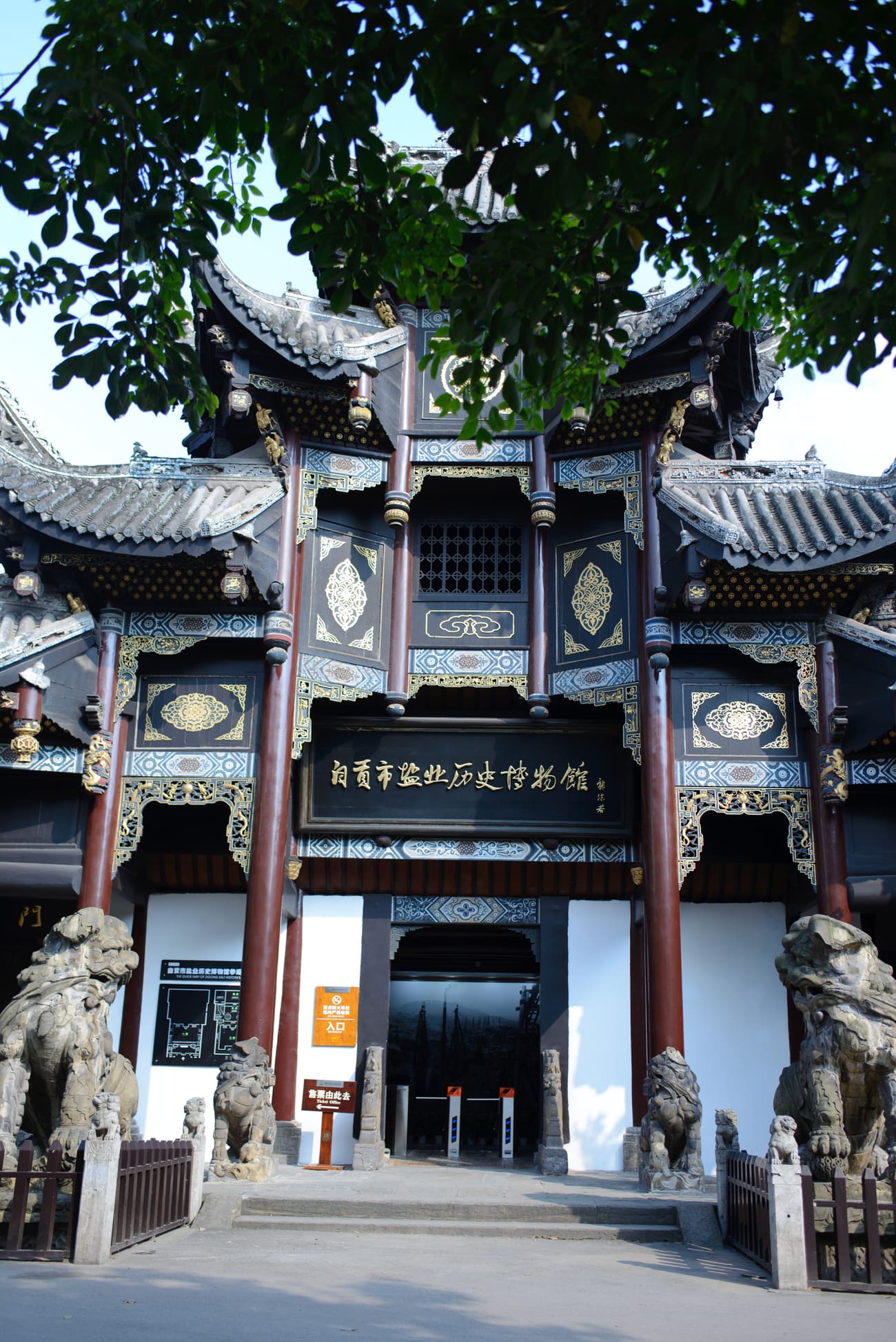
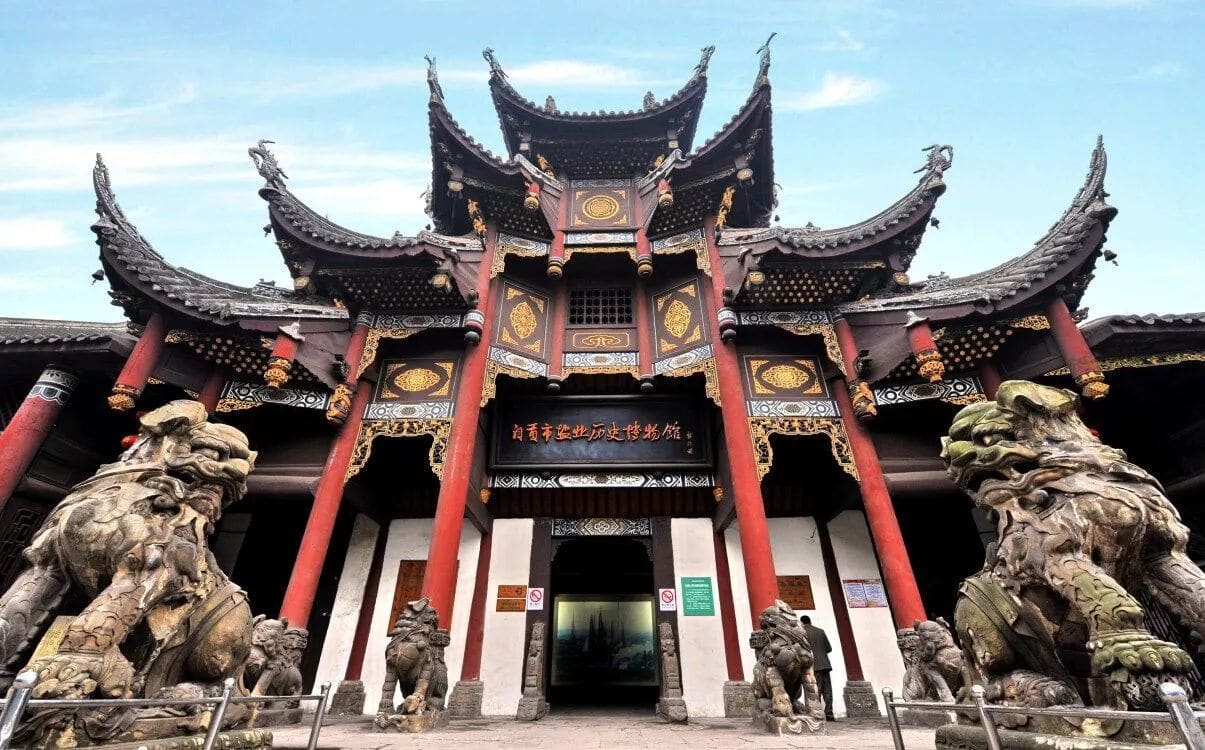
Salt shaped not only the landscape but the society. Drawing brine, conveying it, boiling it, and shipping the salt formed a chain that supported drillers, furnace-masters, boatmen, banks, and trading houses. Merchants from Shaanxi and Shanxi amassed fortunes here and fixed that wealth in guildhalls and mansions — the finest of them, the Xiqin Guildhall (西秦会馆), is today the home of the Salt Industry History Museum (盐业历史博物馆). The name “Zigong” is itself a salt story: it fuses a character from each of the district’s two most famous salt sources, Ziliujing (自流井) and Gongjing (贡井).
A salt merchant’s estate: the Wang family courtyard
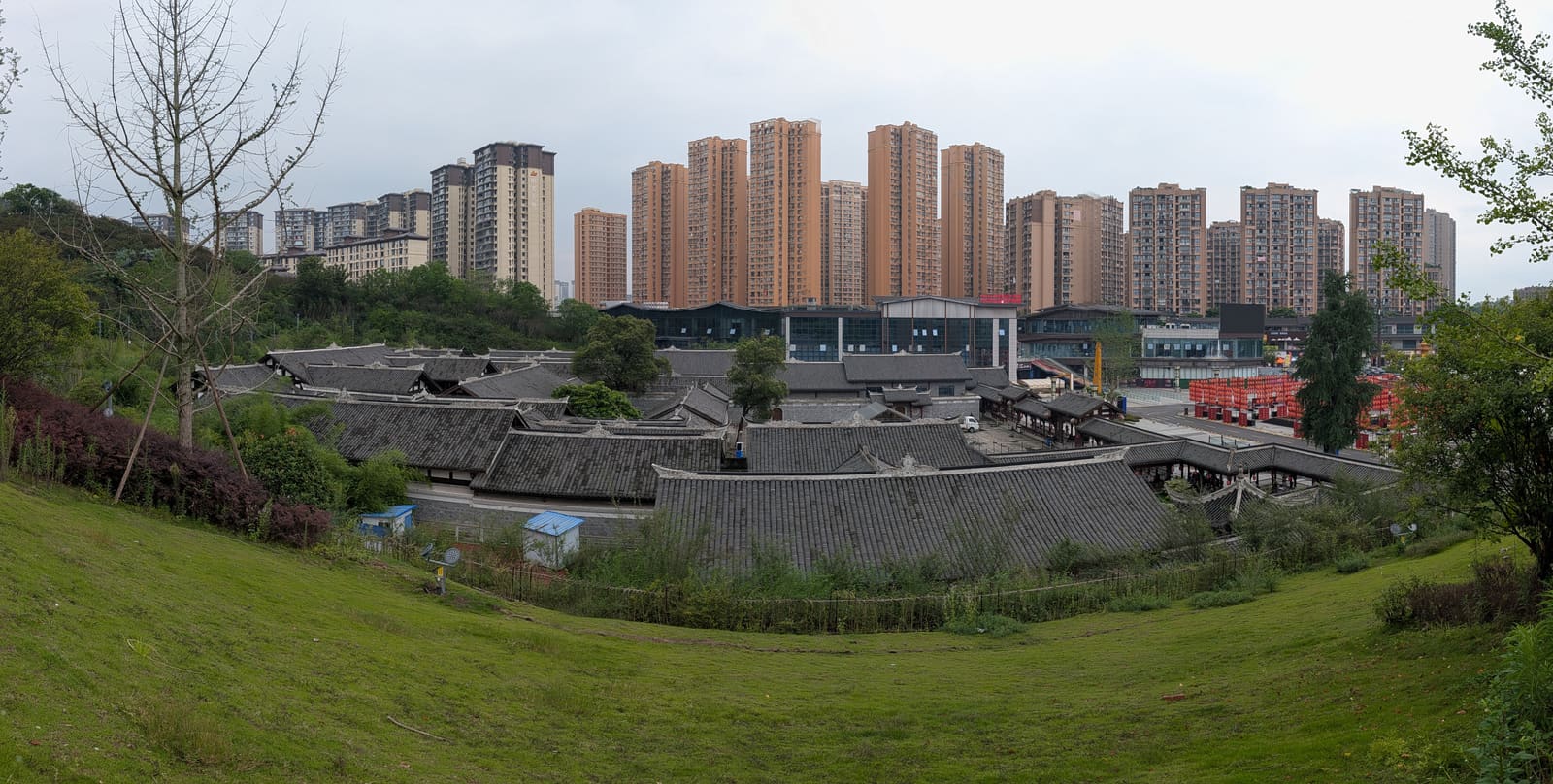
The wealth salt produced did not only raise guildhalls; it raised family estates. The largest to survive is the Wang Family Estate (王家大院; also the Zicheng Ancestral Hall, 子诚公祠) at Ciba’ao (糍粑坳), in today’s Yantan District (沿滩区).
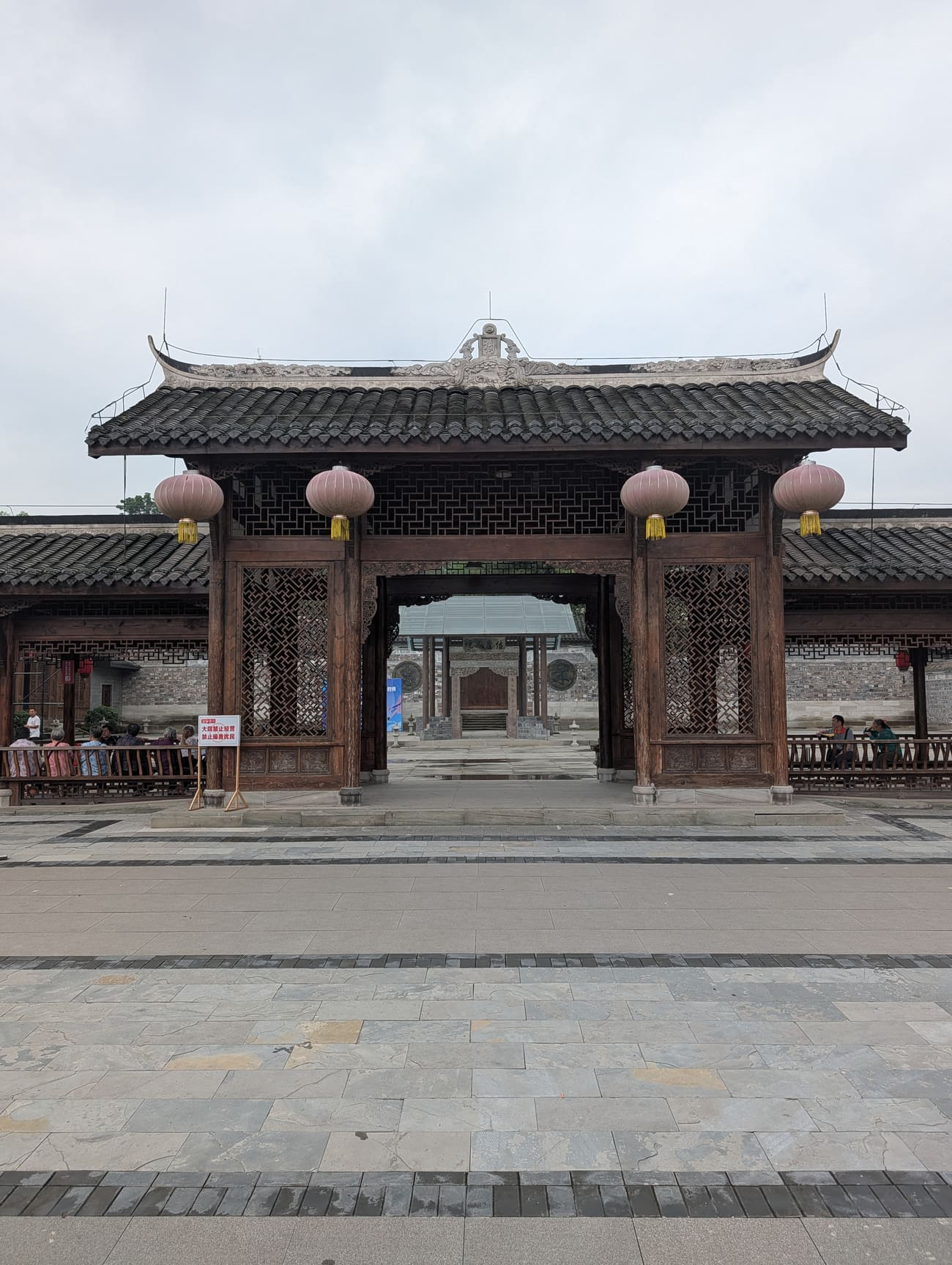
Its builder, Wang Hefu (王和甫, 1867–1930), was a rushang (儒商) — a scholar-merchant — of the Wang Sanwei lineage (王三畏堂), foremost of the “four great salt houses” (老四堂) of Qing-dynasty Zigong (the Wang, Li, Hu, and Yan houses). In 1890 he and his brothers began the estate to honour their father, Wang Zicheng (王子诚); it took six years and was finished in 1896. The compound covers some eleven mu (about 4,500 m² of building) — a Sichuan column-and-tie timber mansion of four linked courtyards, approached by a forty-metre stone path to a five-metre half-moon pool, with a grove of nanmu beside it; more than 600 carvings in stone, wood, and stucco survive.
The most telling touch is a stone plaque above the gate: “a hut among men” (结庐人境), from Tao Yuanming (陶渊明)‘s line, “I built my hut among men, yet hear no clatter of carriage and horse.” A man rich on salt chose a recluse-poet’s words for his own lintel. Beyond the house, Wang petitioned the Fushun (富顺) county office to establish a township around it and laid out a market street, with market days on every 1st, 4th, and 7th of the lunar ten-day cycle — a single estate that grew a small town.
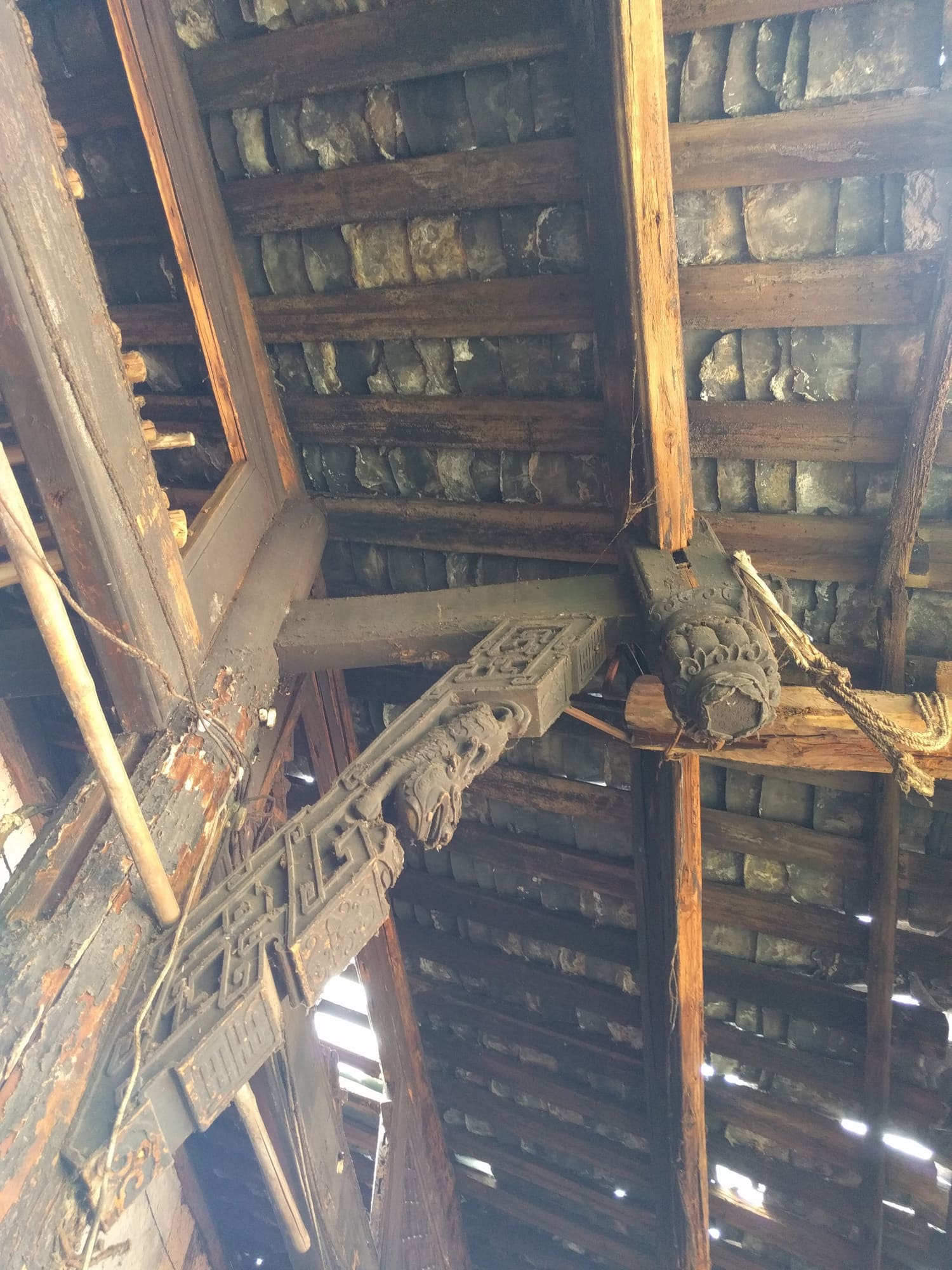
The courtyards then absorbed layer upon layer of modern history: raided by bandits in 1911 but saved through Wang’s efforts; a base for the Communist underground in the 1920s–30s; and, from 1923, home to the “Wang Estate School.” After 1949 it served as a primary school and later a dormitory, and over the following decades fell into disrepair — as the older photographs show. Only recently was it listed among Zigong’s first protected well-salt heritage sites (2020) and restored, to become a museum of Salt-Gang cuisine (盐帮菜); in 2025 the adjoining Salt-Merchant Opera-Stage (盐商大戏楼) opened next door, where the estate’s history is now displayed.
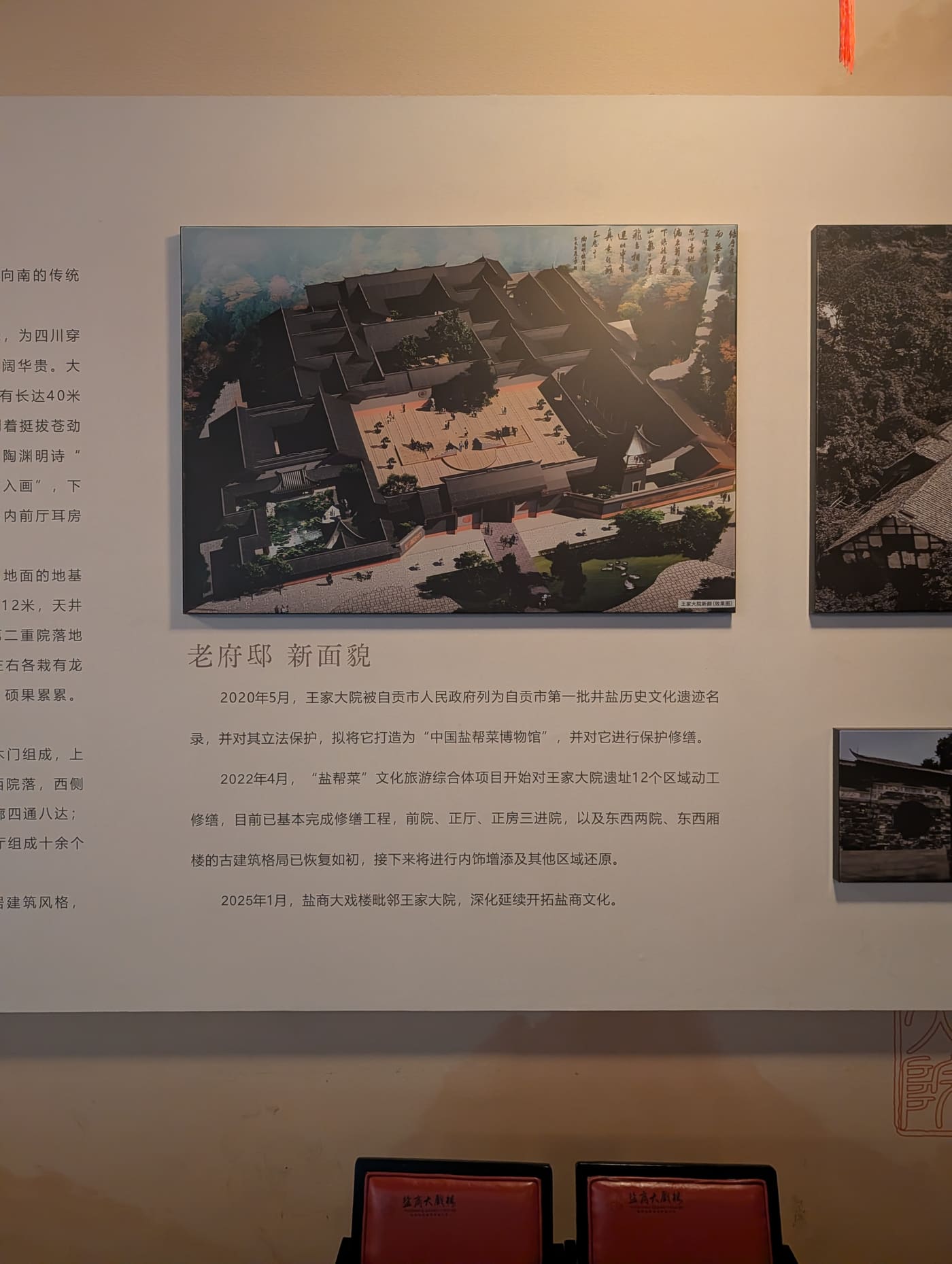
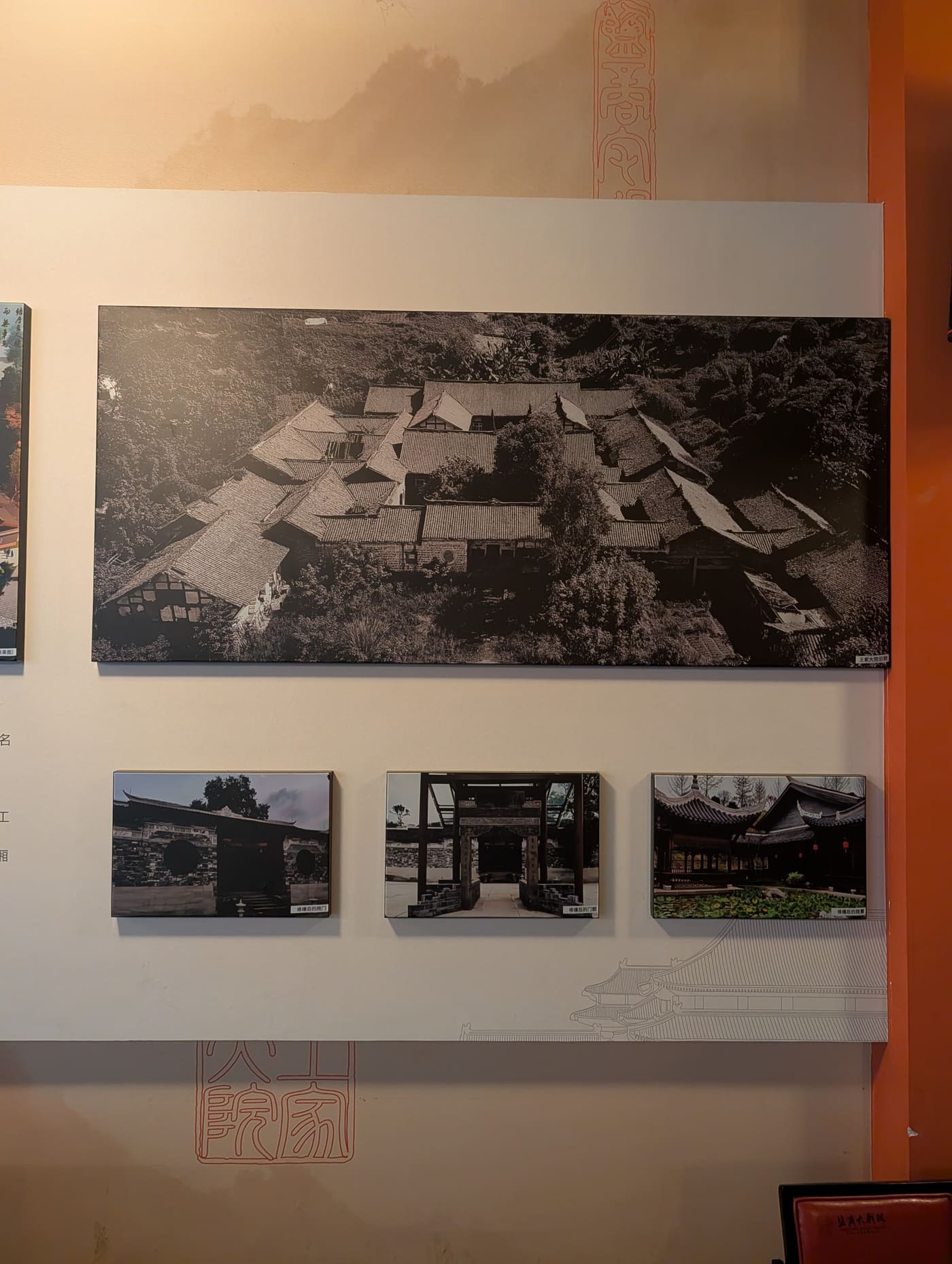
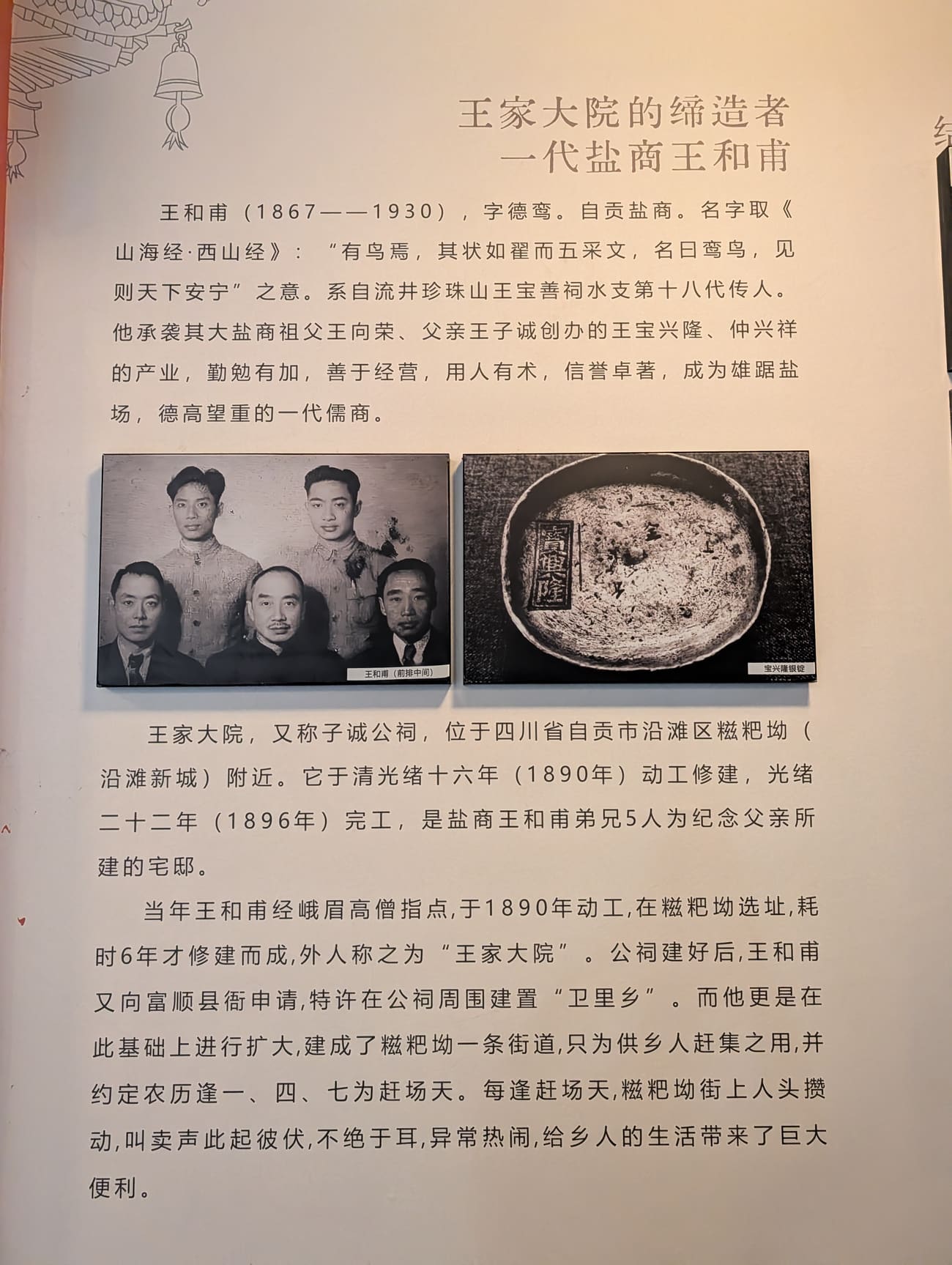
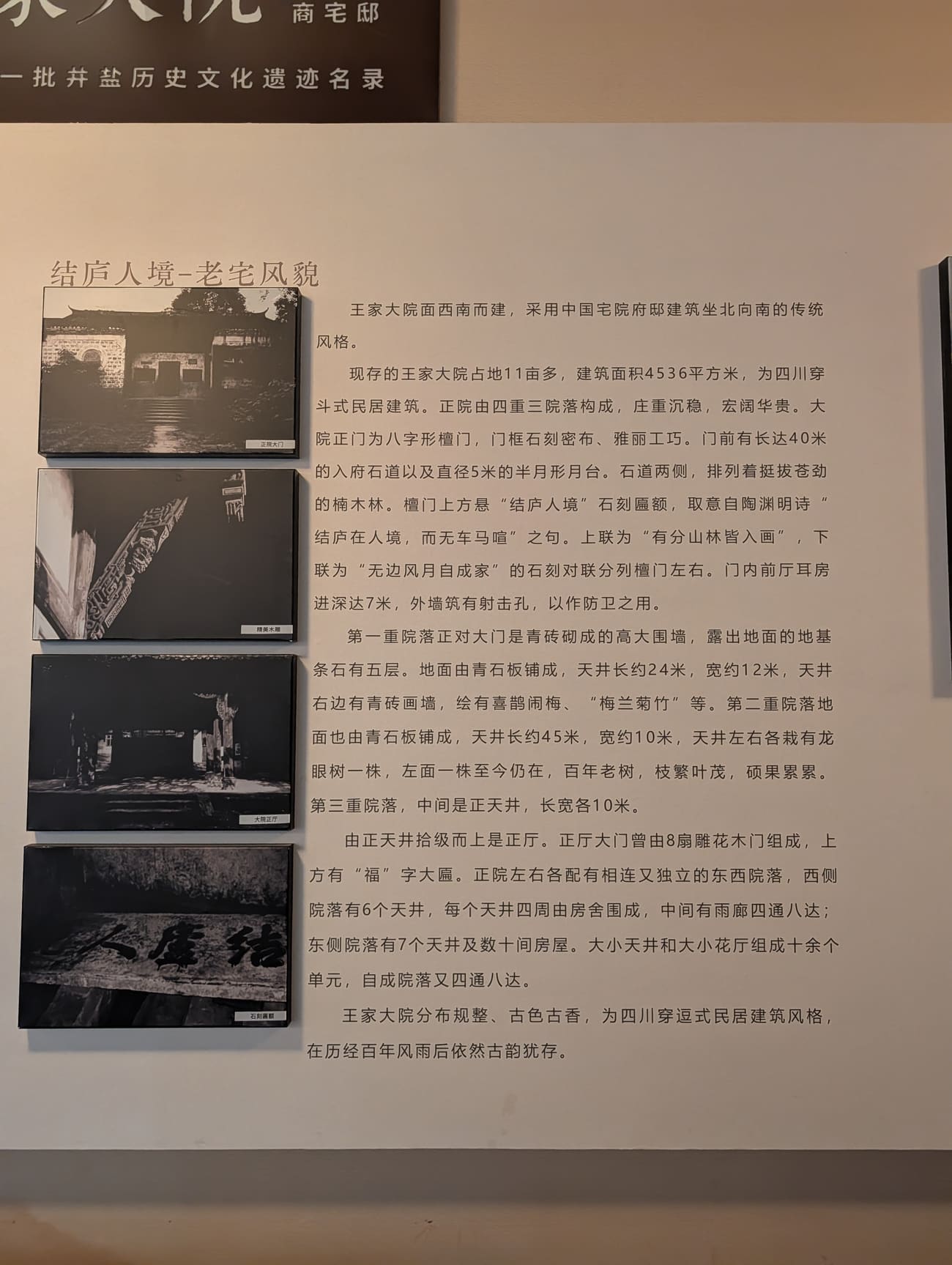
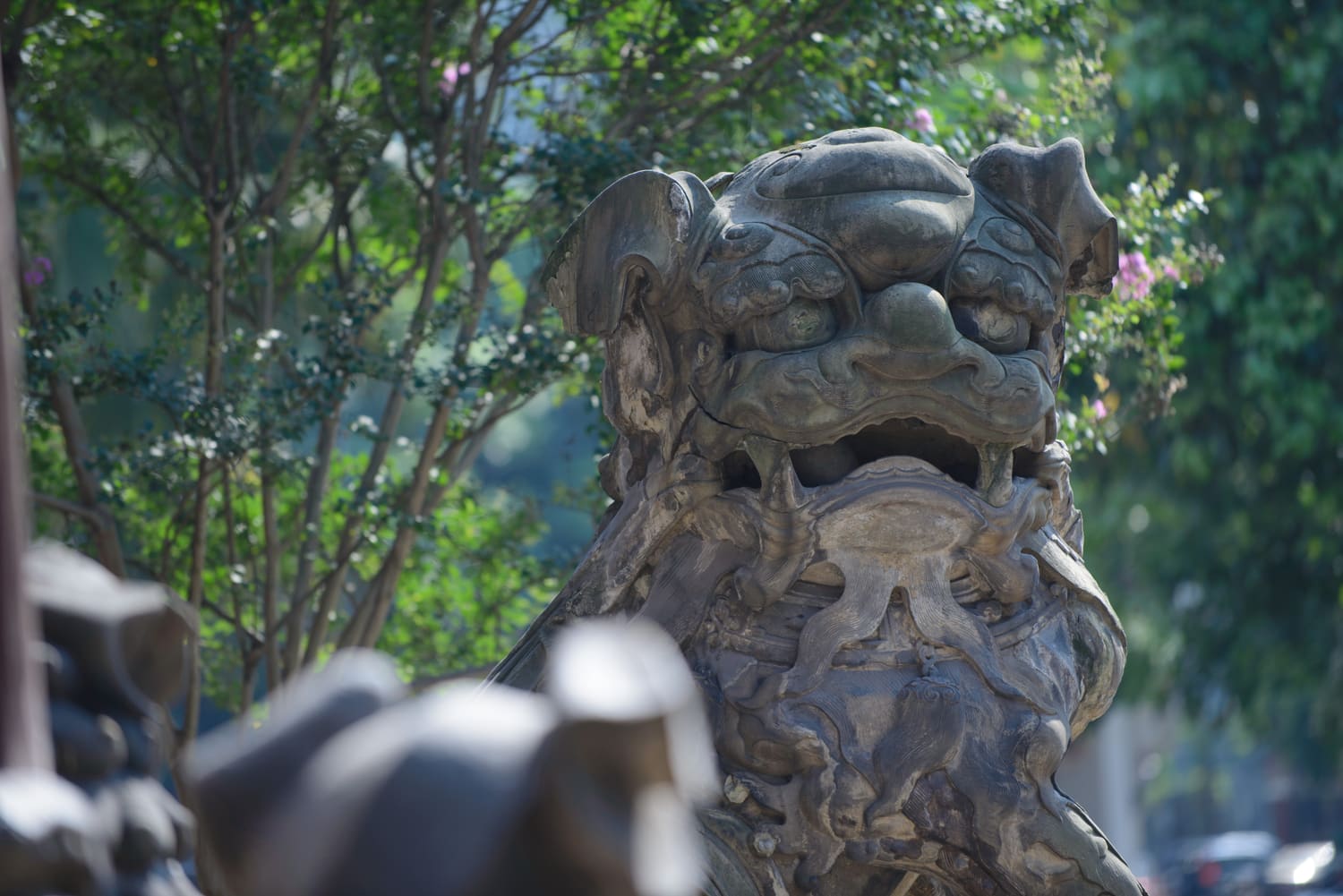
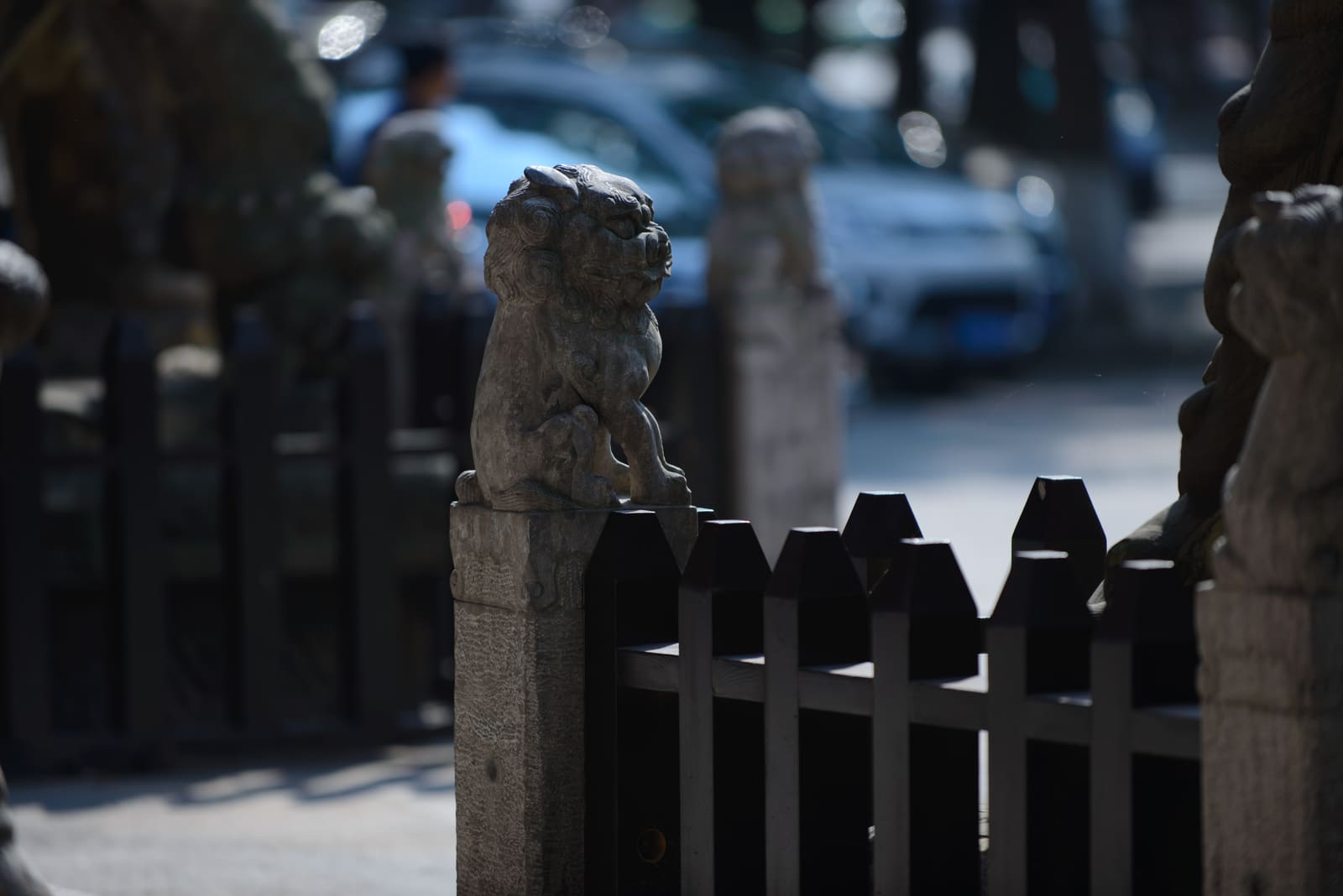
The carved members in that last panel were never the great houses’ alone. The same camel-hump bracket (驼峰) and moulded strut turn up on the beams of ordinary buildings across Zigong — some kept, some cleared, as the city goes.
The salt capital at war
In the twentieth century, salt gave Zigong a chapter both heavy and proud. After war came and the coastal salt fields fell, Sichuan well-salt became a lifeline for unoccupied China; production was driven hard. It was under that wartime pressure that Ziliujing and Gongjing were merged into a single municipality in 1939 — the formal birth of Zigong.
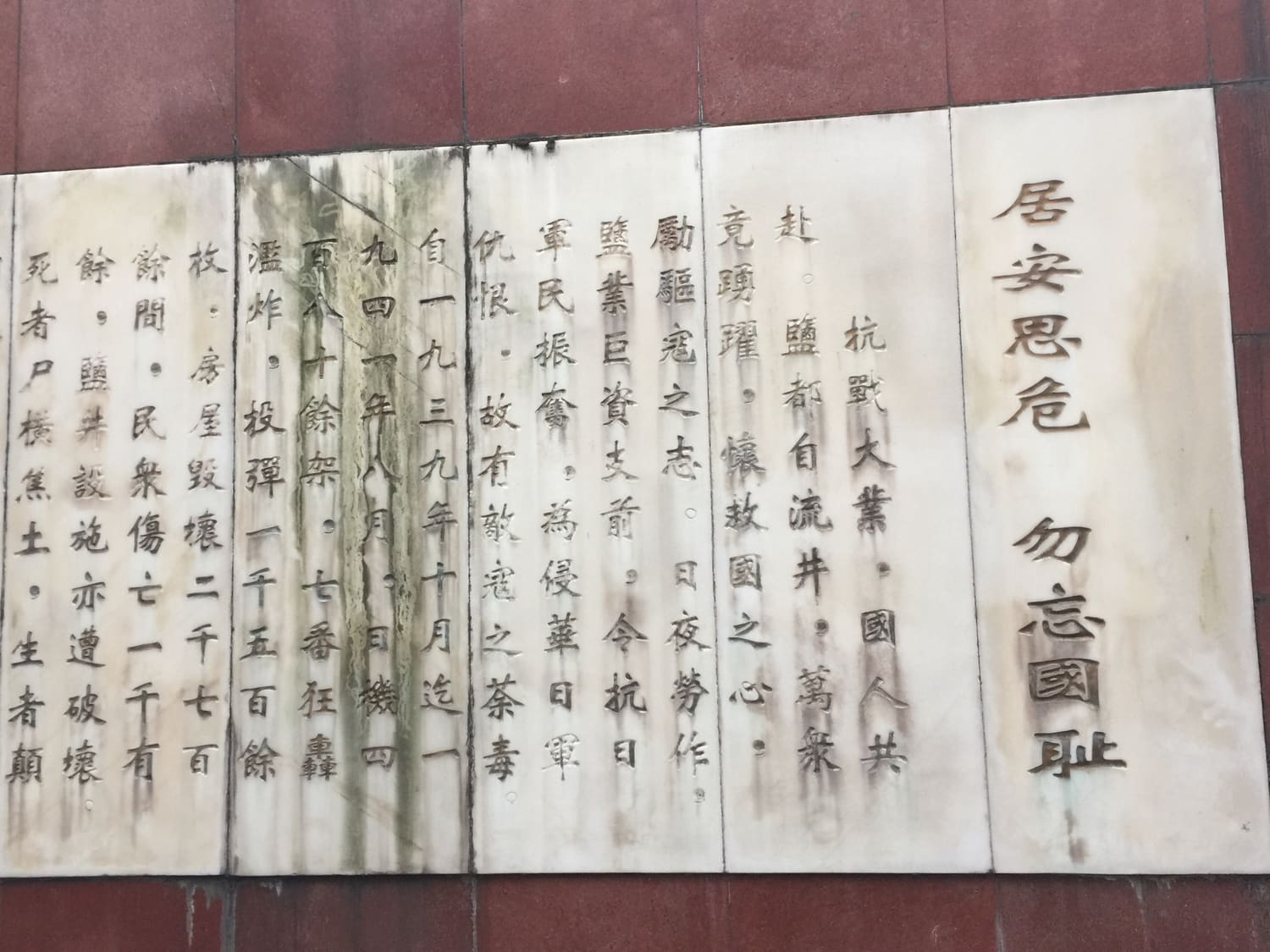
As a strategic industry supplying the front, the salt capital became a bombing target. According to the inscription on the city’s memorial, between October 1939 and August 1941 Japanese aircraft struck in seven raids — more than 480 sorties dropping over 1,500 bombs — destroying more than 2,700 buildings, killing or wounding over a thousand people, and damaging the salt works themselves. Even so, the city’s giving led the nation: answering General Feng Yuxiang (冯玉祥)‘s patriotic donation drive, Zigong alone contributed more than 120 million yuan, the highest of any place in China. (That “120 million” was wartime fabi 法币, amid runaway inflation, so any present-day figure is only an order of magnitude: by purchasing power, perhaps a couple of million US dollars today — though at the time it was enough to buy two warplanes for the front.)
After the war, salt slowly gave ground to other industries in the national economy, but it never truly left. Shenhai still yields salt, the Xiqin Guildhall has become the museum that tells the story, and “salt capital” remains the phrase by which the city understands itself.
Appendix: the memorial inscription
The wall stands in the city, dated September 1997. Translated from its (partly weathered) text:
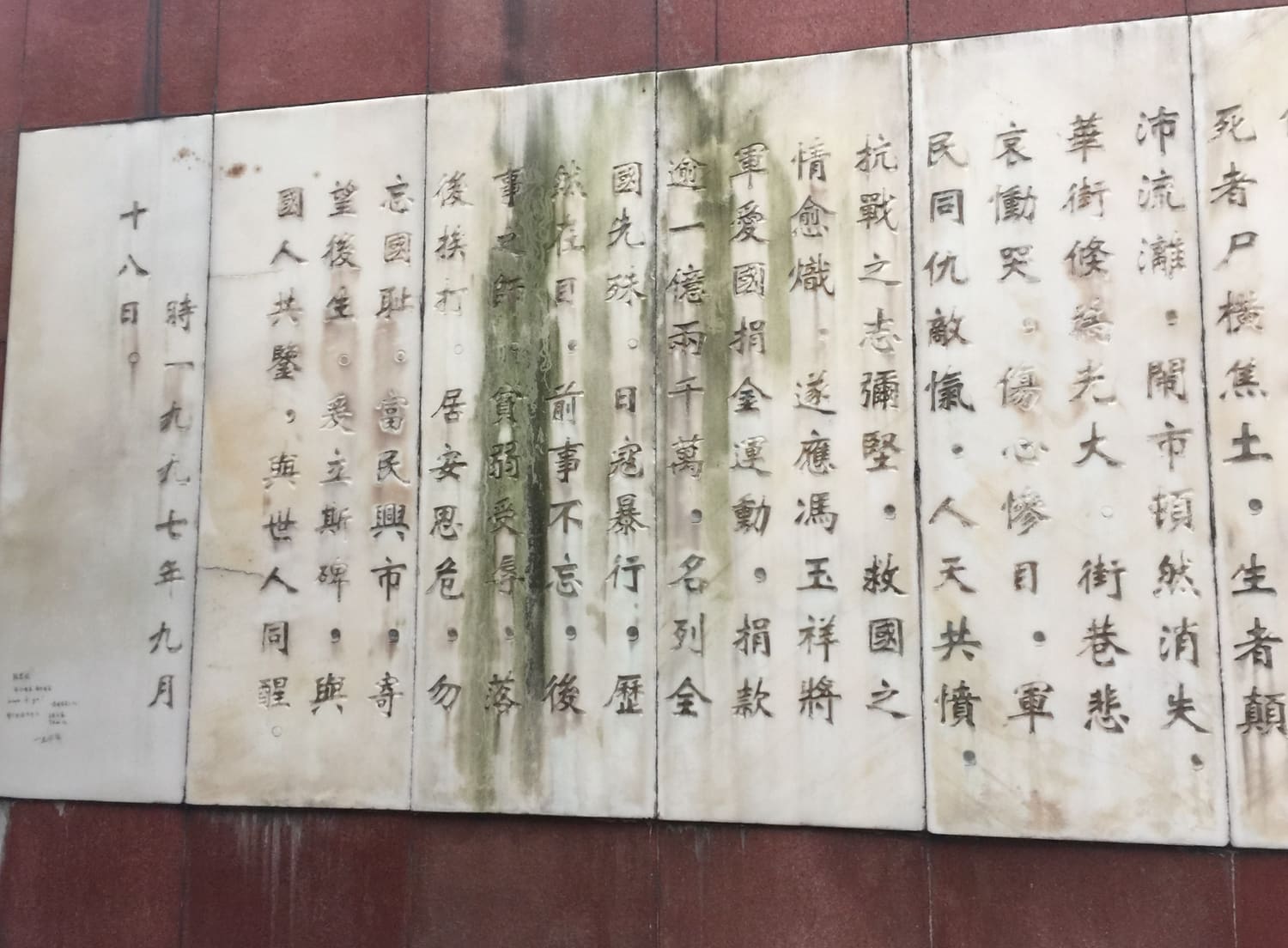
In safety, remember danger; never forget national humiliation.
The great war of resistance was a cause the whole nation took up. In the salt capital of Ziliujing the people threw themselves forward, hearts set on saving the country, labouring day and night, the salt industry’s great wealth sustaining the front… And so came the enemy’s ravages: between October 1939 and August 1941, Japanese aircraft — more than 480 sorties in seven waves of indiscriminate bombing — dropped over 1,500 bombs, destroyed more than 2,700 buildings, killed or wounded over a thousand people, and damaged the salt wells. The dead lay across the scorched earth; the living were scattered… Soldiers and civilians shared one hatred of the foe. Answering General Feng Yuxiang’s patriotic donation campaign, contributions here exceeded 120 million — first in the nation… This stele is raised that our countrymen and the world may remember.
— September 1997
(An excerpt of the legibly preserved portions; a few weathered passages are reconstructed from context.)
Dinosaurs
The salt that made Zigong (自贡) rich and the dinosaurs that made it famous come from the same geological gift. The red sandstone of the Sichuan Basin sealed away both the brine left by ancient evaporating seas and the bones of Mesozoic reptiles. The salt lies deep; the bones lie nearer the surface — and at Dashanpu (大山铺), northeast of the city, you can dig almost anywhere and strike remains 160 million years old.
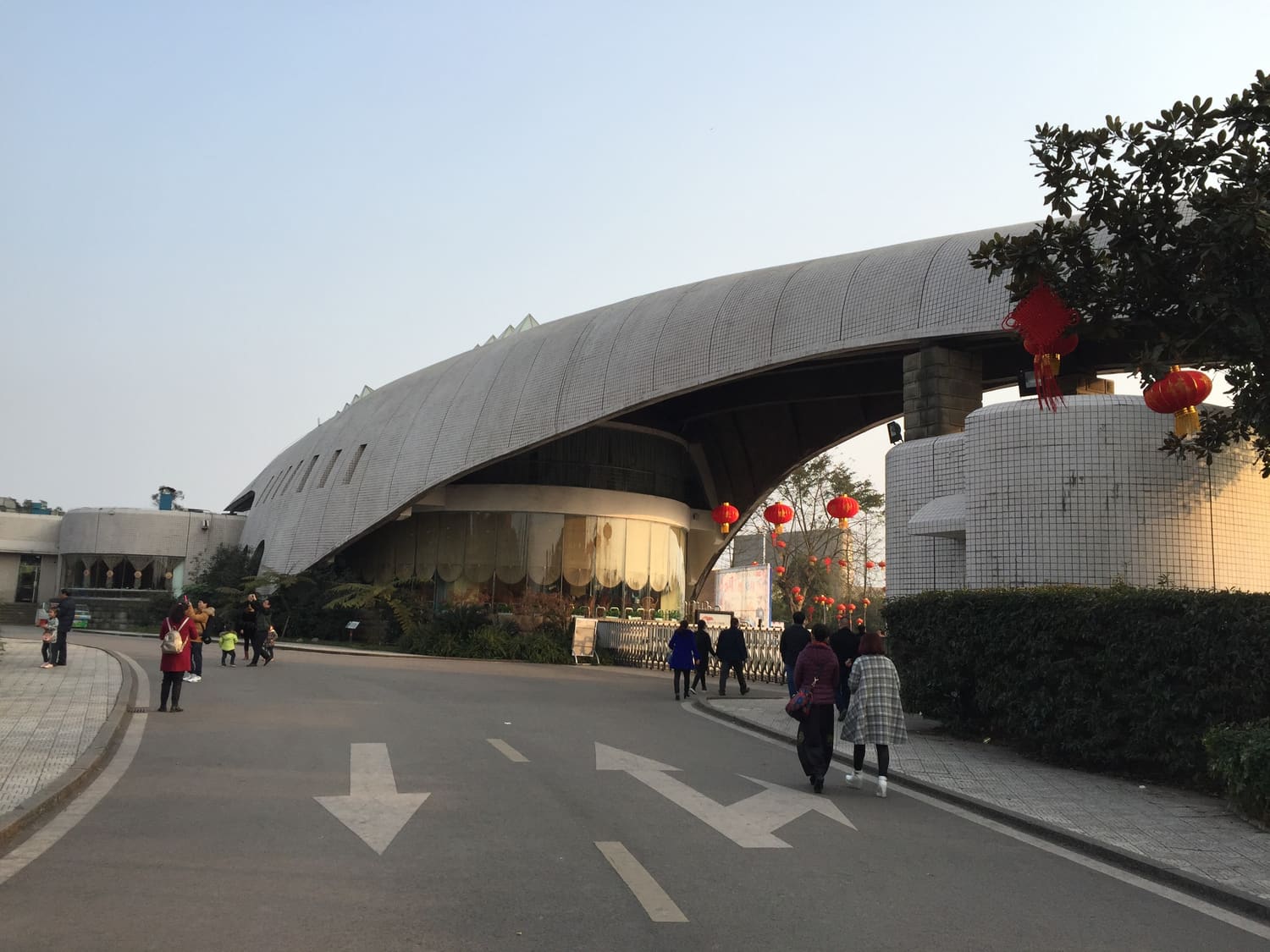
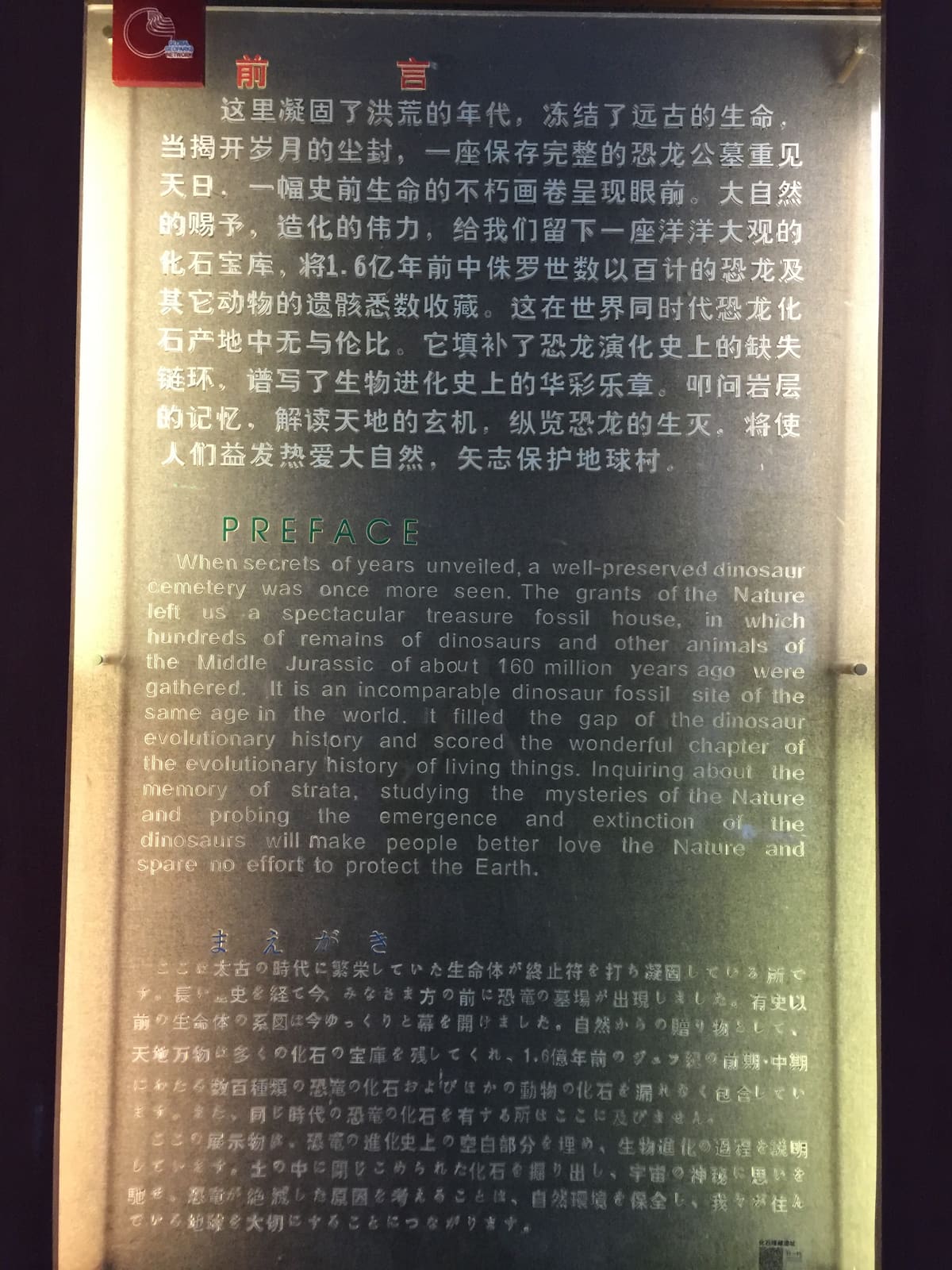
In the 1980s geologists uncovered an unusually complete Middle-Jurassic graveyard here: not scattered fragments of a single dinosaur, but an entire fauna — fish, turtles, crocodile relatives, and flying reptiles included — densely preserved in the Shaximiao Formation (沙溪庙组). This “whole-community” preservation is rare almost everywhere else, which is why the site’s diversity is considered, by some measures, unmatched in the world. Rather than ship the fossils elsewhere, China built the museum directly over the bonebed: the Zigong Dinosaur Museum (自贡恐龙博物馆) opened in 1987, the first dinosaur museum in Asia and one of only a handful in the world set on the dig itself.
The dinosaurs named for the city
Among the many dinosaurs found here, two carry the name of this very ground — a local stamp that fossils elsewhere rarely bear.
Zigongosaurus (自贡龙, “Zigong lizard”), named in 1976, is a medium-sized sauropod some fifteen metres long. It is almost a microcosm of the puzzle of Jurassic Chinese sauropods: the material is fragmentary and its identity is still argued over — some fold it into Omeisaurus (峨眉龙), some into Mamenchisaurus (马门溪龙), and some insist it stands as its own genus. That a single name can sustain an argument this long says something true about the bonebed: it has left palaeontology nearly as many questions as answers.
Dashanpusaurus (大山铺龙), named for the township where it was dug up, is known from a skeleton lacking its skull. Its significance runs deeper than the local name: recent re-examination argues it may be among the earliest-diverging macronarians — and earliest known neosauropods — yet found, implying that this great branch of later dinosaurs originated earlier, and ranged more widely, than once thought. A fossil beneath a small Sichuan town, in other words, may have rewritten the timetable for a whole lineage of dinosaurs.
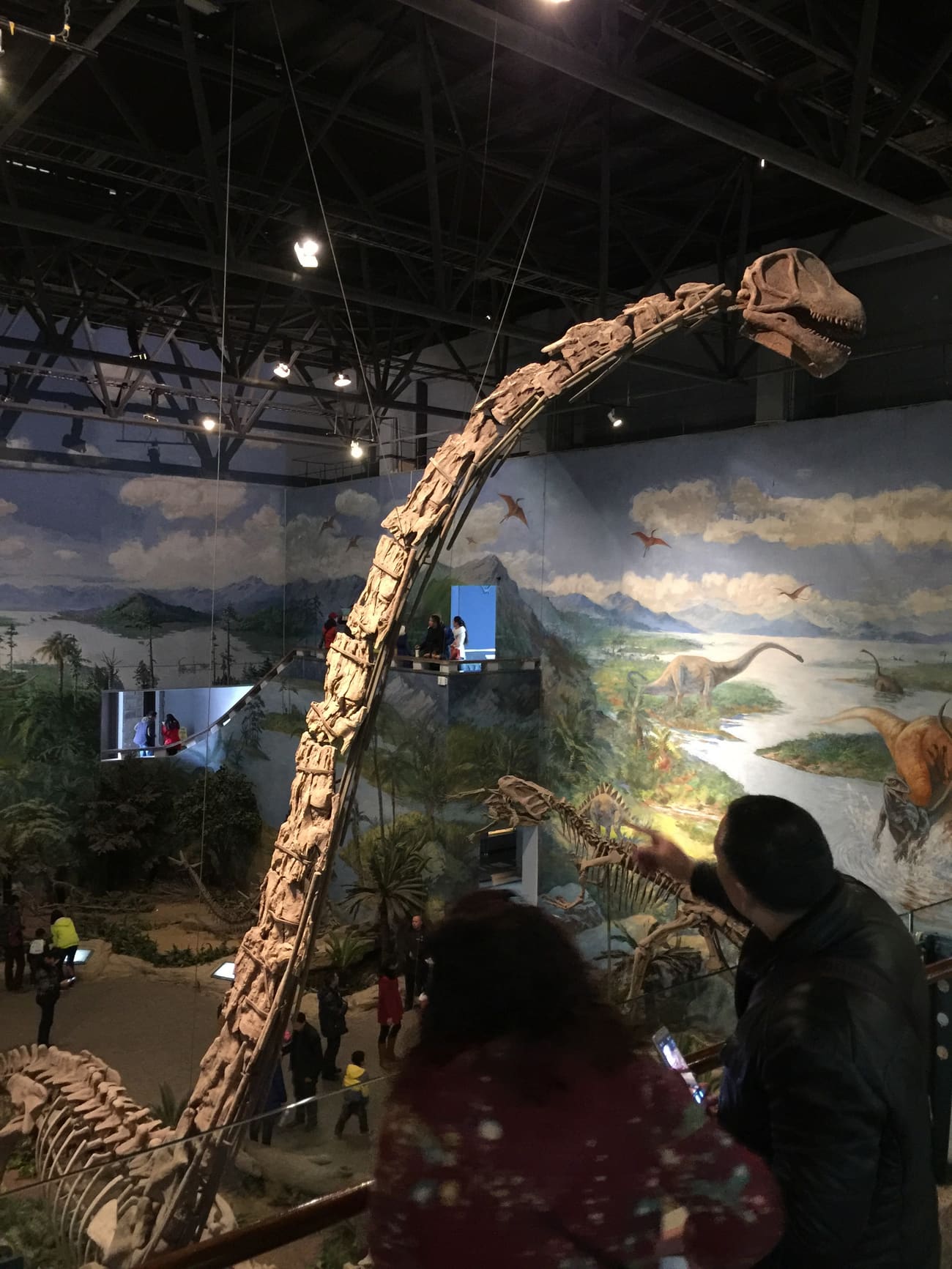
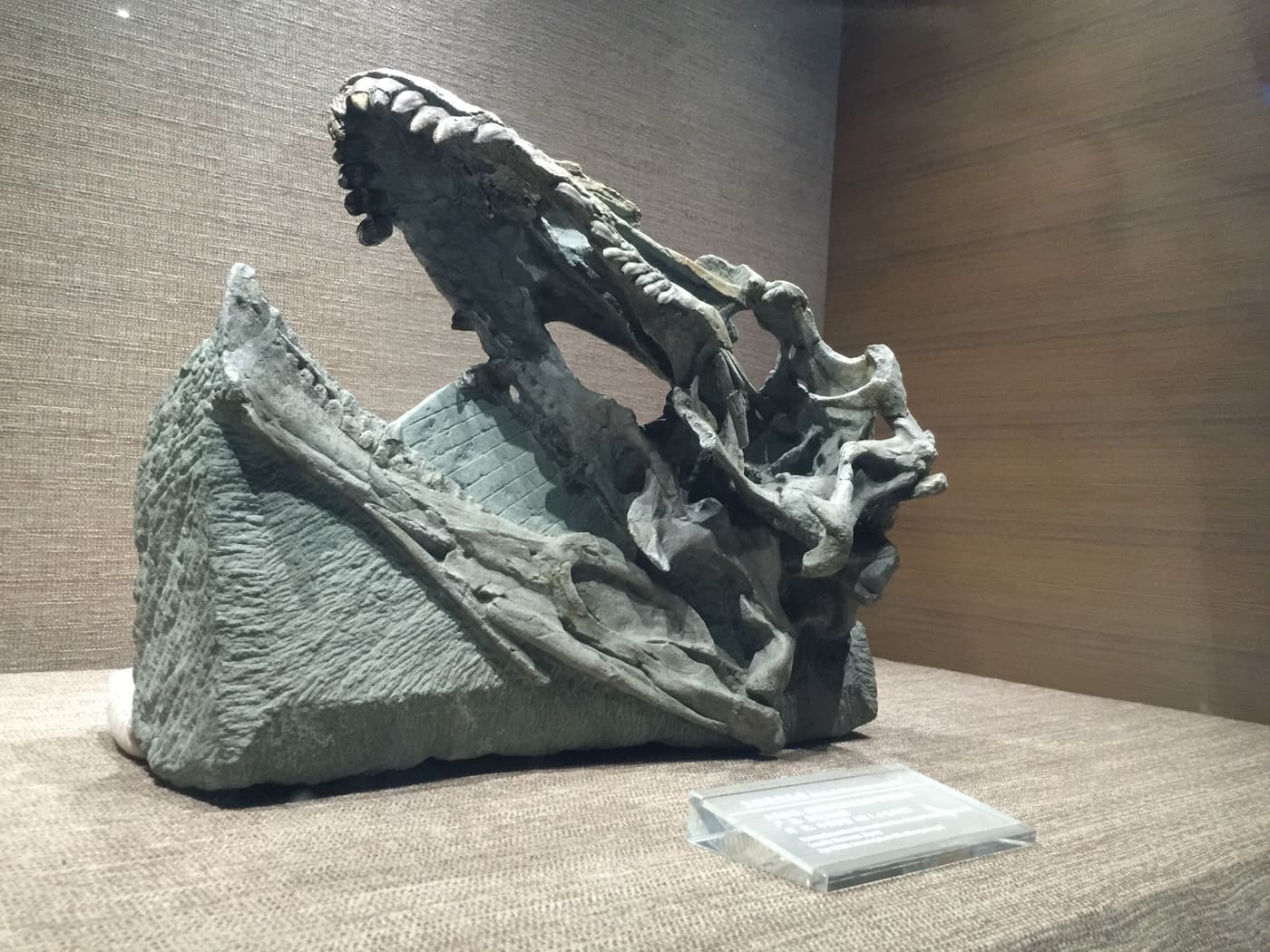
The museum holds other celebrated species too, though their names come from elsewhere: the absurdly long-necked Omeisaurus (named for Mount Emei, 峨眉山), the Gigantspinosaurus (巨棘龙) with its enormous shoulder spines (named for the feature), and the region’s big Jurassic predator, Yangchuanosaurus (永川龙) (named for Yongchuan, 永川).
So a city built on salt acquired a second identity as the “home of dinosaurs.” It is not an arbitrary pairing: it is exactly why the festival here is the Dinosaur Lantern Festival, and why luminous sauropods drift above the New Year crowds. Salt and dinosaurs are the two deep, improbable inheritances the same ground handed this city.